FAA Color Vision Test 2025: New Computerized Testing Rules for Pilots
Last Updated: January 2025 | Reading Time: 6 minutes
The FAA retired Ishihara plates in January 2025. Here's what pilots need to know about the new computerized color vision testing requirements.
What Changed with FAA Color Vision Testing in 2025?
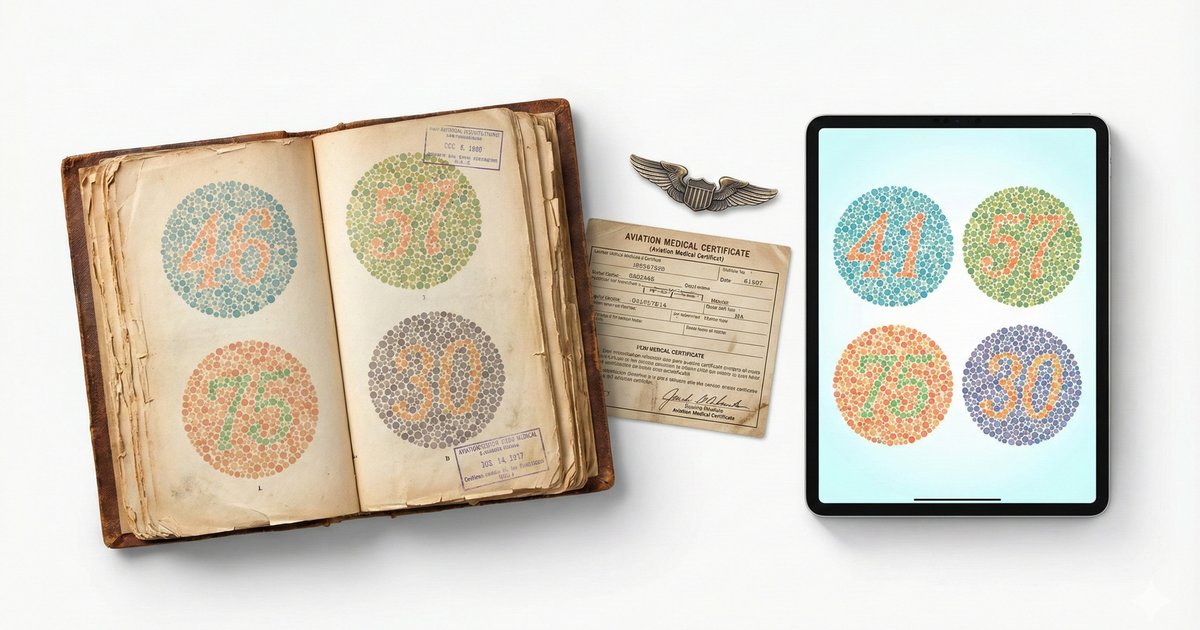
Effective January 1, 2025, the FAA replaced traditional Ishihara pseudoisochromatic plate tests with mandatory computerized color vision testing for all new pilot medical certificate applicants. The familiar books filled with colored dots hiding numbers are no longer accepted for FAA medical certification.
Key changes to FAA color vision testing:
- Ishihara plates and 18 other legacy tests are no longer FAA-approved
- Only three computerized color vision tests are now accepted
- Digital tests display randomized patterns that cannot be memorized
- Color vision screening is now a one-time requirement for most pilots
- Existing pilots with unrestricted medicals are grandfathered
The FAA implemented these changes following a 2002 NTSB safety recommendation after a FedEx Boeing 727 crash in Tallahassee, Florida, where the first officer's color vision deficiency was identified as a contributing factor.
Three FAA-Approved Computerized Color Vision Tests
The FAA now recognizes only these three computerized color vision tests for pilot medical certification:
1. City Occupational Colour Assessment & Diagnosis (CAD Test)
The CAD test (AVOT-PRO-US) was developed by City University in London and measures red-green and blue-yellow color discrimination under aviation-specific standards.
- Accuracy: Highest precision of the three approved tests
- Cost: Equipment exceeds $10,000
- Availability: Less common in general AME offices due to cost
2. Rabin Cone Contrast Test (RCCT)
The RCCT test was originally designed for U.S. military aviation (Air Force, Army, Navy, Coast Guard) and evaluates each eye's cone cell response to red, green, and blue stimuli.
- FAA passing score: 55 or higher for each color channel (red, green, blue)
- Testing method: Each eye tested separately
- Track record: Years of proven reliability in military pilot screening
3. Waggoner Computerized Color Vision Test (CCVT)
The Waggoner CCVT is a modern digital color plate test available for Windows, iPad, and Android devices.
- FAA passing score: 21 or higher out of 25 on general screening
- Tests for: Red-green (protan/deutan) and blue-yellow (tritan) deficiencies
- Cost: Approximately $1,000 for software license
- Availability: Most widely available due to lower cost
Important: Pilots can attempt any or all three tests. Passing just one satisfies the FAA color vision requirement.
Do Pilots Need to Take the Color Vision Test Every Medical Exam?
No. Under the 2025 FAA policy, color vision testing is a one-time requirement for most pilots.
The FAA recognizes that color vision deficiency is typically a stable, hereditary condition that doesn't change with age. Once you pass an approved computerized color vision test, you won't need to retest at future medical exams.
Exceptions requiring retesting:
- Taking medications that affect color vision (e.g., sildenafil/Viagra)
- Developing eye conditions affecting color perception (glaucoma, advanced cataracts, macular degeneration)
- Upgrading from third-class to first- or second-class medical certificate
Are Existing Pilots Grandfathered from New Color Vision Testing?
Yes. Pilots who held a medical certificate without a color vision limitation before January 1, 2025 are grandfathered under the new policy.
Grandfathering rules for FAA color vision testing:
| Pilot Status | New Test Required? | Action |
|---|---|---|
| Current medical, no color vision limitation | No | AME marks "Pass" on future exams |
| First/second class with SODA or LOE | No | Continue under existing authorization |
| Third class with SODA or LOE (keeping third class) | No | No retesting required |
| Third class upgrading to first/second class | Yes | Must pass computerized test |
| First-time applicant (2025 or later) | Yes | One-time computerized test required |
What Happens If You Fail the FAA Color Vision Test?
Failing the computerized color vision test does not end your flying career.
If you cannot pass any of the three approved tests, the AME will issue a third-class medical certificate with limitation #104: "Valid for day visual flight rules (VFR) only."
What limitation #104 means for pilots:
- You can fly during daylight hours under VFR conditions
- No night flying operations
- No flying requiring color signal recognition
- Many recreational pilots are minimally impacted
Options for removing the color vision limitation:
- Appeal to the Federal Air Surgeon
- Pursue operational testing pathways (OCVT)
- Medical Flight Test (CV MFT) through local FSDO
Approximately 7-8% of men and 0.5% of women have some form of color vision deficiency. Color blindness limits the scope of your flying—it doesn't eliminate it.
How to Prepare for Your FAA Color Vision Test
Tips for First-Time Medical Certificate Applicants
Pre-test before your AME appointment. Find an eye specialist with FAA-approved computerized tests and get evaluated before your official medical exam. AMEs accept proof of successful tests from other providers.
Verify your AME has testing equipment. Not all AMEs have purchased computerized testing systems. Call ahead to confirm availability. Some AMEs refer pilots elsewhere for color vision testing.
Understand your options. You can attempt all three approved tests. Failing one doesn't prevent trying others. There's no limit on number of attempts.
Know the passing scores:
- CAD: Normal RG score (varies by diagnosis)
- RCCT: 55+ for each color (red, green, blue)
- Waggoner: 21+ out of 25 on general screening
Frequently Asked Questions: FAA Color Vision Test 2025
Can I still use Ishihara plates for my FAA medical exam?
No. As of January 1, 2025, Ishihara pseudoisochromatic plates are no longer accepted for FAA pilot medical certification. Only the three approved computerized tests (CAD, RCCT, Waggoner CCVT) are valid.
How much does FAA color vision testing cost?
Costs vary by AME and test used. The Waggoner CCVT software costs AMEs approximately $1,000, while CAD equipment exceeds $10,000. Expect additional fees ($25-100) added to your standard medical exam cost if your AME performs the test in-office.
Can color blind pilots get an FAA medical certificate?
Yes. Pilots with color vision deficiency can receive a third-class medical certificate with a day-VFR-only limitation. Some color deficient pilots may also qualify for unrestricted certificates through operational testing and medical flight tests.
Do I need a color vision test if I already have a pilot certificate?
Only if your current medical certificate has a color vision limitation you want removed, or if you're upgrading from third-class to first- or second-class medical. Otherwise, pilots with unrestricted certificates are grandfathered and don't need retesting.
Which FAA color vision test is easiest to pass?
The tests measure different aspects of color perception, so results vary by individual. Approximately 35% of color vision deficient applicants can pass at least one of the three approved tests. The Waggoner CCVT is most widely available; try all three if needed.
Can I wear color-correcting glasses or contacts for the FAA color vision test?
No. The FAA does not accept X-Chrom lenses, ColorMax glasses, or other color vision correcting devices as a means for meeting color vision standards. You must pass the test with your natural color vision or standard corrective lenses.
Key Takeaways: FAA Color Vision Testing 2025
- January 2025: FAA retired Ishihara plates, now requires computerized testing
- Three approved tests: CAD, RCCT, Waggoner CCVT (pass any one)
- One-time testing: Pass once, no retesting required (with exceptions)
- Grandfathered: Existing pilots without limitations don't need new testing
- Failure isn't fatal: Day-VFR limitation available; flying continues
- Pre-test recommended: Verify color vision before official AME exam
Official Sources and References
- FAA Guide for Aviation Medical Examiners – Color Vision
- FAA Color Vision Screening Steps
- FAA Acceptable Computer Color Vision Tests (PDF)
- FAA Color Vision FAQ (PDF)
- AOPA: Color Vision Test Not Required If Previously Passed
- AOPA: New Rules for Color Vision Testing
- AOPA: Color Restriction Removal
Disclaimer
This article is for informational and educational purposes only and does not constitute official FAA guidance, medical advice, or legal counsel. Color vision requirements and testing procedures may change. Always consult the current FAA Guide for Aviation Medical Examiners for authoritative requirements. Contact your Aviation Medical Examiner (AME) or a qualified aviation medical consultant for guidance specific to your situation.
PilotPrep is an independent resource and is not affiliated with the FAA, AOPA, or any government agency.
Ready to prepare for the CogScreen-AE?
Start training with our adaptive cognitive modules designed specifically for pilots. Get instant access to real-time scoring and performance tracking.
Start Free Trial