Does Practice Actually Improve Performance?

Does Practice Actually Improve Performance?
TL;DR. For years, the advice pilots received about preparing for a cognitive evaluation was that practice doesn't help. It was an opinion held by some experts, and it persisted with no data to prove it otherwise. We studied our user community over the last six months: a statistical analysis of hundreds of users and over 18,000 practice sessions, using aggregated and anonymized data. The result was not guaranteed, and we had committed to publishing it whichever way it came out. Pilots who started low gained more than 20 points. Three in four pilots with room to improve got better. Every module improved. Pilots who started near the top still improved at the margin, from 99.5% to a perfect 100%. The prevailing assumption that practice does not help is not what our data shows.
Data vs Opinion
If you have been told you need a CogScreen-AE evaluation, I can guess the first question you asked, because every pilot asks it: can I practice for this?
For years, the answer you would have heard was no. Practice doesn't help, pilots were told, or it helps in a way that does not count. That advice came from some experts in the field, and it was an opinion. It persisted because there was no data to prove it otherwise. A cognitive evaluation happens once, in one clinician's office, and the result goes into one pilot's file. Nobody pooled those results, and nobody followed a large group of pilots through weeks of practice to see what changed.
We could. PilotPrep's AI-enabled coaching works by analyzing how you perform on each practice task, things like accuracy, response time and the difficulty level you reach, and turning that into feedback: where you have room to improve, what is trending the right way, and what deserves your attention next. The same kind of information, aggregated and anonymized, lets us ask something the field has never been able to ask. Across a large group of pilots, what does practice actually do?
So over the last six months we studied our own user community: a statistical analysis of hundreds of pilots and more than 18,000 practice sessions. To our knowledge it is the first study of its kind on the types of tasks this evaluation uses.
I want to say one thing before the results. The outcome was not guaranteed. In August we told our readers we would run this analysis and publish it whichever way it came out, and an honest analysis can go either way. It could have shown that practice makes little difference, which would have been an uncomfortable finding for a preparation platform to report. We would have reported it. That is what transparency means.
Here is what we found.
Testing the Conventional Wisdom
The conventional wisdom says practice is pointless at best, and at worst inflates a score without changing anything real. Some experts hold that view, and it has shaped what pilots are told for years.
It has never been tested. The commentary that makes the case offers reasoning, not measurement: no group of pilots who practiced, no comparison, no numbers. Until now there was no data to test it with.
Here is how I would test it, and you can judge the logic for yourself. If practice were an inflation trick, it would lift everyone by about the same amount, because everyone learns the same trick. If practice builds real understanding of a task, the gains would follow the gap: large for pilots who start low, smaller for pilots who are nearly there, and marginal for pilots already near the top.
The science cited most often in this debate points the same way. The practice effect is the well-replicated finding that people perform better on a cognitive task once they have done it before. That finding does not say practice is meaningless. It says practice changes performance, and that familiarity with a task matters.
So we ran the test.
Bigger Gap, Bigger Gain
To make this concrete, imagine two pilots sitting down to practice Manikin for the first time. They are an illustration, not real people.
The first has never seen anything like it. A small figure appears, sometimes upright, sometimes upside down, sometimes facing away, and he has to say which hand is holding the flag. He gets four in ten right and feels his stomach drop. The second has spent fifteen years reading approach plates and rotating airport diagrams in her head. She gets nine in ten right on her first try and wonders what the fuss is about.
Practice will do something different for each of them, and that difference is the story of this study.
We looked at each pilot's record on each module, wherever there were at least six sessions, and compared the first three sessions with the last three.
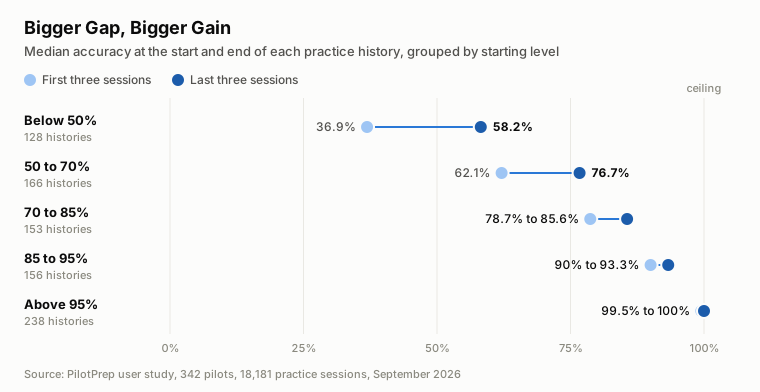
| Where a pilot started | Median gain | Improved | Median finish |
|---|---|---|---|
| Below 50% | +20.5 points | 82% | 58% |
| 50 to 70% | +15.1 points | 81% | 77% |
| 70 to 85% | +7.2 points | 78% | 86% |
| 85 to 95% | +2.4 points | 67% | 93% |
| Above 95% | marginal, 99.5% to 100% | most finish at a perfect score | 100% |
The result is clear. The lower a pilot starts, the more practice delivers. Pilots who started below 50%, like our first pilot, gained more than 20 points. Pilots in the middle gained 7 to 15. Pilots who started near the top, like our second, improved at the margin, because the margin is all that is left. A pilot who begins at 99.5% has half a point of scale above them, and the typical pilot in that group finishes at a perfect 100%.
Among everyone with room to improve, 77% got better, by about 8 points for the typical pilot and 11 on average. For every practice record that declined, nearly four improved: 464 to 127. The odds of a split like that happening by chance are far below one in a trillion.
This settles the inflation argument. A trick would lift everyone equally. Our data shows gains that follow the gap. That is what learning looks like.
Effects of Practice
Start and finish averages do not show you the path between them. This chart does. It follows the first ten sessions for pilots who completed at least ten on a module.
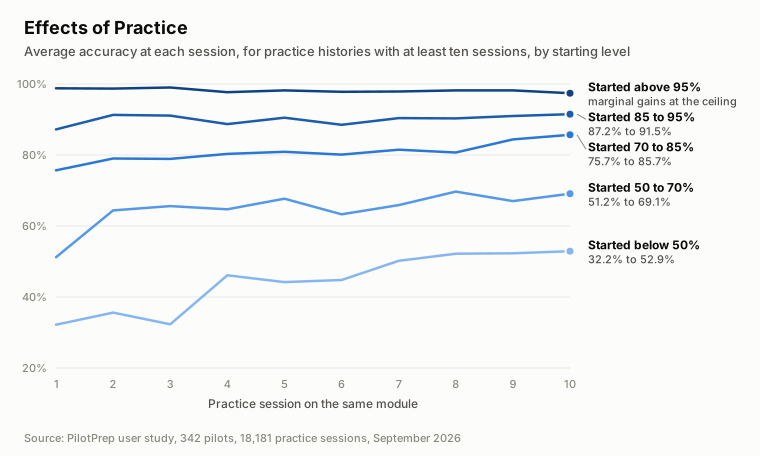
Three things stand out to me.
The lowest starters climb the most, and keep climbing. From 32% in the first session to 53% by the tenth, and the line is still rising.
The biggest jump often comes early. Pilots who started between 50% and 70% go from 51% to 64% between their first and second sessions. A rule worth remembering: your first attempt measures surprise. Your second starts to measure you.
The strongest pilots improve at the margin. They start within a point or two of perfect, so there is very little room left, and they still take it: a typical start of 99.5% and a typical finish of 100%.
Results by Test
Practice helped on every test. How much depends on the test. These are the gains for pilots who started below 85% on a module.
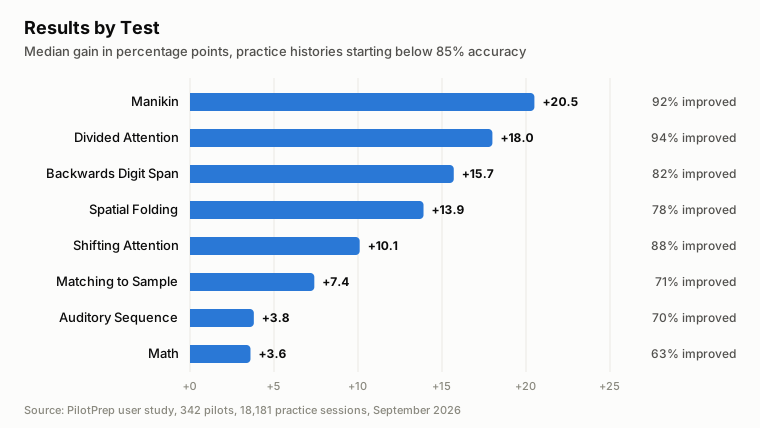
| Module | Median gain | Improved |
|---|---|---|
| Manikin, judging orientation of a rotated figure | +20.5 points | 92% |
| Divided Attention, tracking two things at once | +18.0 points | 94% |
| Backwards Digit Span | +15.7 points | 82% |
| Spatial Folding | +13.9 points | 78% |
| Shifting Attention | +10.1 points | 88% |
| Matching to Sample | +7.4 points | 71% |
| Auditory Sequence | +3.8 points | 70% |
| Math under time pressure | +3.6 points | 63% |
Every module improved, and on every module most pilots improved. If these module names are new to you, our subtest guide explains what each one asks of you.
The biggest gains are on tasks with an unfamiliar format. Almost nobody has practiced judging which hand an upside-down figure is using, or tracking two things at once. Nine in ten pilots improve on those once the format is no longer new.
The smaller gains are on skills you have used all your life. Mental arithmetic and auditory memory are already well practiced, so there is less unfamiliarity to remove. Pilots still improve on them.
A trick for beating tests would have no reason to favor Manikin over Math. Real familiarity does. It is also why generic brain games do not carry over: what moves the needle is familiarity with these specific task formats.
The Sweet Spot
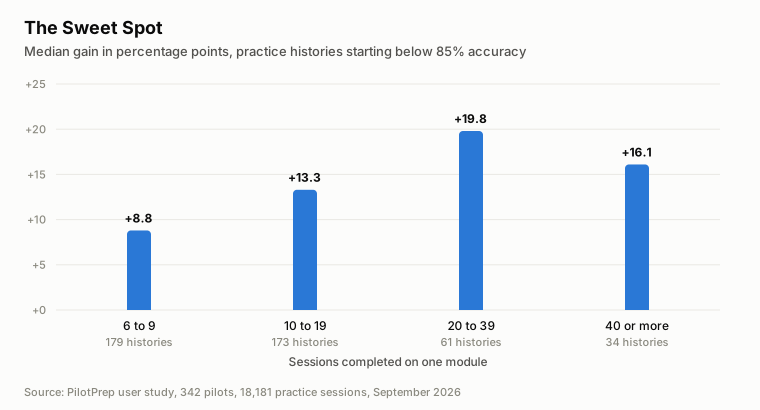
| Sessions on one module | Median gain |
|---|---|
| 6 to 9 | +8.8 points |
| 10 to 19 | +13.3 points |
| 20 to 39 | +19.8 points |
| 40 or more | +16.1 points |
More practice brings more gain. The strongest results come from twenty to forty sessions on a single module. When more of something produces more of the effect, that is one of the clearest signs the thing itself is doing the work.
Your accuracy also understates your progress. The practice engine raises the difficulty as you improve. More than twice as many practice records moved up in difficulty level as moved down, and among pilots who started below 50%, 73% were working at a harder level by the end. They were getting more right against harder material.
What Practice Builds
Put the four charts together and the answer is plain. Practice builds fluency with the task: the format, the pacing, the interface, the rhythm. On the day, all of your capacity goes to the work, and none of it goes to figuring out what is being asked. (Here is what the day itself looks like.)
Go back to our first pilot. On day one he spends the first minute of every Manikin figure working out the question. A hundred figures later, he just answers. Same brain. Now he is showing it.
These are not arbitrary puzzles, which is why that matters. When Stanford researchers tested 118 pilots on the CogScreen-AE and then put them in a flight simulator, four CogScreen factors explained 45% of the difference in how well they flew (Taylor et al., 2000). The abilities are real and they belong in the cockpit. Practice does not manufacture them. It clears away the unfamiliarity that hides them.
This is how aviation already works. Nobody flies a checkride without having flown the profile. Nobody sits a type rating oral without studying the systems. Pilots practice for everything that matters, and a cognitive evaluation is no exception.
Built on Published Standards
Our results carry weight because of how PilotPrep is built. Our modules follow the task mechanics described in the published literature on this battery. Our scoring rests on the professional pilot norms the U.S. Air Force published in AFRL-SA-WP-TR-2012-0001, with a composite modeled on the published logistic-regression approach and referenced to the thresholds reported in the test manual and in the FAA's own studies. I explain those in what the LRPV means and how to read your scores.
We have been open about all of it from day one: how the scoring works, why we changed it when the published norms showed a ceiling effect, which norms we use, and who writes for us. This study is the next step. We are now publishing what happens to the pilots who use the platform, not only how it is built.
What to Expect
Starting low on a module? Expect a large gain. More than 20 points is typical below 50%, and better than four in five improve. If that is you after a real evaluation, start with what to do when results come back low.
In the middle? Expect steady, meaningful gains. Between 50% and 85%, typical gains run from 7 to 15 points.
Already strong? Expect marginal gains. A couple of points in the high eighties and low nineties, and the last fraction of a point above that. Your bigger return is on your weakest module.
Expect modules to respond differently. Manikin and Divided Attention respond fastest. Math and Auditory Sequence respond more slowly. Plan your time accordingly.
How to Practice
If I were coaching you through the next month, this is what I would have you do.
Find your weakest module and work on that one. Spread forty sessions across ten modules and you get four sessions each, too few to move any of them. Put the same forty into your two weakest modules and you are in the range where the typical gain was nearly twenty points.
That is why PilotPrep scores every module against pilot norms and shows you which ones are pulling your profile down. Diagnose first, then practice.
- Run a full battery once and read your profile. Our guide to preparing for the CogScreen-AE walks through how.
- Pick your two weakest modules and put twenty to forty sessions into each. That is where the data shows the largest gains.
- Track the level you reach, not just accuracy. A rising level means you are improving against harder material, even when the percentage looks flat.
Curious where you would start? Run the battery once and look at your own profile before you decide anything else.
What We Measured
These results measure performance on PilotPrep's practice modules, which follow the published task mechanics and are scored against published pilot norms. The official CogScreen-AE is given and interpreted by a licensed neuropsychologist, and the score that counts for certification is theirs to report. What our data shows is that pilots who start out unfamiliar with these tasks become fluent in them through practice, measurably and in large numbers.
We will keep running this analysis as more pilots train with us, and we will keep publishing what it shows, whichever way it points. The method is fixed and the code is version-controlled, so every future run can be compared directly with this one.
Keep Reading
- FAA ADHD Certification 2026: Fast Track vs Standard Track
- 5 mistakes pilots make on the CogScreen-AE, and how to avoid them
- If Every Pilot Took the CogScreen, How Many Would Fail?
Methodology
This study covers 342 pilots and 18,181 practice sessions, analyzed on September 17, 2026, using aggregated and anonymized performance data. A practice history is one pilot's sessions on one module; histories with at least six sessions are used to measure change over time, which gives 841 practice histories. Gain is the mean accuracy of the last three sessions minus the mean of the first three, in percentage points. "Improved" means a gain above zero. Among histories starting below 95%, 464 improved, 127 declined and 12 were unchanged (two-sided sign test, z = 13.9, p < 0.001). Histories starting above 95% begin at a median of 99.5% and finish at a median of 100%. Learning curves use histories with at least ten sessions and plot the mean accuracy at each session. Module and session-volume results are restricted to histories starting below 85%, and the module table lists the modules with the largest samples, from 101 histories for Backwards Digit Span to 24 for Manikin. No personally identifying information is used and no individual pilot's results are reported.
Sources
- PilotPrep user study: 342 pilots and 18,181 practice sessions, aggregated and anonymized, September 2026. Analysis and charts are reproducible from version-controlled scripts.
- Taylor, J.L., O'Hara, R., Mumenthaler, M.S., & Yesavage, J.A. (2000). Relationship of CogScreen-AE to Flight Simulator Performance and Pilot Age. Aviation, Space, and Environmental Medicine, 71(4), 373-380.
- King, R.E. et al. (2011), AFRL-SA-WP-TR-2012-0001, U.S. Air Force School of Aerospace Medicine: professional pilot normative data, including Table 13 on ceiling effects
- What Pilots Should Know About CogScreen-AE Preparation Services (2026), clinician commentary representative of the prevailing view discussed above
- FAA, Guide for Aviation Medical Examiners
About the author: Dr. Jordan "Coach" Keller is an AI aviation educator and subject matter expert employed by PilotPrep LLC. His domain knowledge spans FAA aeromedical certification, CogScreen-AE test design and scoring, HIMS AME protocols, Special Issuance pathways, neuropsychological assessment in aviation contexts, and 14 CFR Parts 67 and 61 medical standards. He writes to help pilots navigate the FAA medical system with accurate, regulation-grounded information.
Dr. Keller is an AI agent. He is not a licensed physician, psychologist, or attorney, and nothing in this article constitutes medical, legal, or clinical advice. FAA medical certification decisions are made by your Aviation Medical Examiner and, where applicable, the FAA's Aerospace Medical Certification Division. Consult a HIMS AME for guidance specific to your situation. PilotPrep is a preparation and familiarization tool. It is not the CogScreen-AE and is not a diagnostic instrument.
Ready to prepare for the CogScreen-AE?
Start training with adaptive cognitive modules designed specifically for pilots. Real-time scoring, pilot-normed benchmarks, and performance tracking across all 13 subtests.
Start Free TrialStay ahead of FAA changes
Get CogScreen prep strategies and FAA testing updates in your inbox.
No spam. Unsubscribe anytime.
© 2026 PilotPrep™ LLC. All rights reserved. This article is original work and is protected by copyright.
You are welcome to quote or reference it with clear attribution and a link to https://faacogscreen.com/blog/does-practice-improve-performance-analysis/. Republishing it in full, reproducing it on another site, or using it to train machine-learning models is not permitted without written permission. For licensing or reprint requests, contact [email protected].